


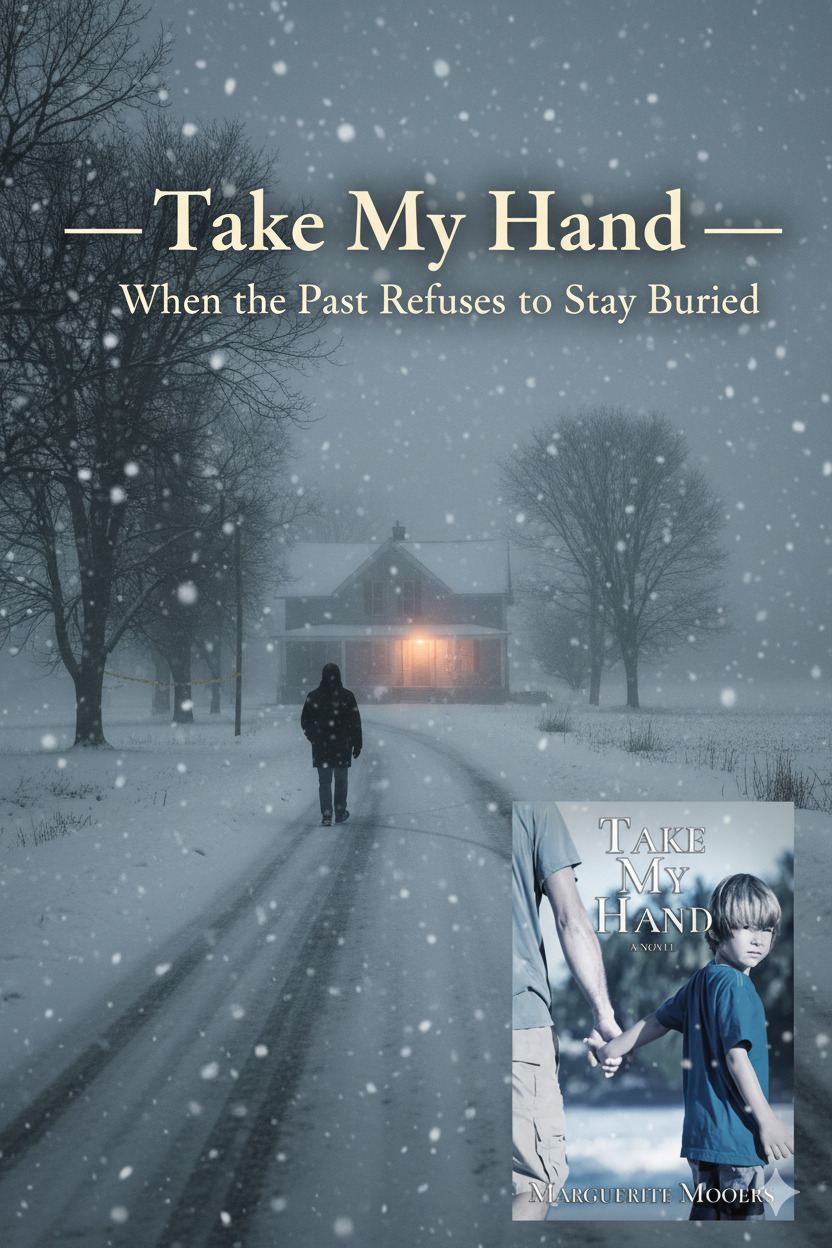
Detective Chris Bellini never wanted a cold case to become personal. The name Ethan LeBrun had long been a headline, a mystery, a question mark in the files. But when Lorna Watson, a teacher at the local medium-security prison, brings forward new evidence about Ethan’s kidnapping and murder, Chris cannot ignore it. What he doesn’t know is that the case is about to touch the parts of him he’d rather leave buried.
Lorna Watson is fragile in ways most people don’t see. Her husband, stricken with Alzheimer’s disease, has become a ghost in the home she once believed safe. When he vanishes from his nursing care, the disappearance sets off a chain of events that digs deeper than the police files ever could. Lorna’s instincts warn her that what’s happening isn’t random: the old crime, the new disappearance, the people she trusted. It all connects.
Marguerite Mooers builds Take My Hand on more than suspense. She weaves ethics and loyalty into the thriller’s fabric. Chris, carrying both grief and professional detachment, is forced to reconcile with what justice really means. Lorna, whose world is unraveling, must ask: how far will she go to find truth when everyone else expects her to stay silent?
The setting—mostly rural northern New York—plays its own role. Mooers doesn’t decorate crime with glam. Instead she situates danger in places that look ordinary: an old farm road, a neighbor’s glance that lasts too long, the hush of winter nights. Atmosphere becomes tension. The wind through bare trees, distant dogs barking, the endless hush of snow cover—all these surround the characters. They aren’t just external details; they amplify internal fears. Chris’s burden, Lorna’s guilt, memory’s unreliability—all these things whisper.
What strikes me about Take My Hand is how the book explores what people owe to each other. What does a character owe a family member lying in memory’s tangle? What does a detective owe a victim? What does a neighbor owe when suspicions point closer than one would like? Mooers pulls no punches about how loyalty can bind as strongly as guilt, and how silence—what people don’t say—can be as dangerous as what they speak.
There is also love in the form of protection. Chris is not a hero built for admiration. He is someone who carries hurt quietly, who weighs consequences. Lorna is a teacher, a daughter, someone whose compassion becomes part of her risk. Mooers refuses easy villains. People are complex, their motives mixed. When Lorna’s missing husband reverts in memory, or when a clue seems damning, Mooers makes us ask: could someone I trust cross a line? Would someone I love?
By the final pages the threads twist. Mooers’ pacing is artful. Suspicion moves from character to character. Secrets hidden in past decades begin unraveling. The weight of truth becomes heavier than the weight of hiding. Take My Hand challenges the reader not only to follow clues but to feel what it costs to bring light into darkness.
If you pick up Take My Hand, expect tension, moral complexity, quiet heartbreak, and resolutions that leave scars. It’s a novel about what we do when we see injustice and what we do when we ourselves carry pieces of it. It is Mooers at her gripping best.